


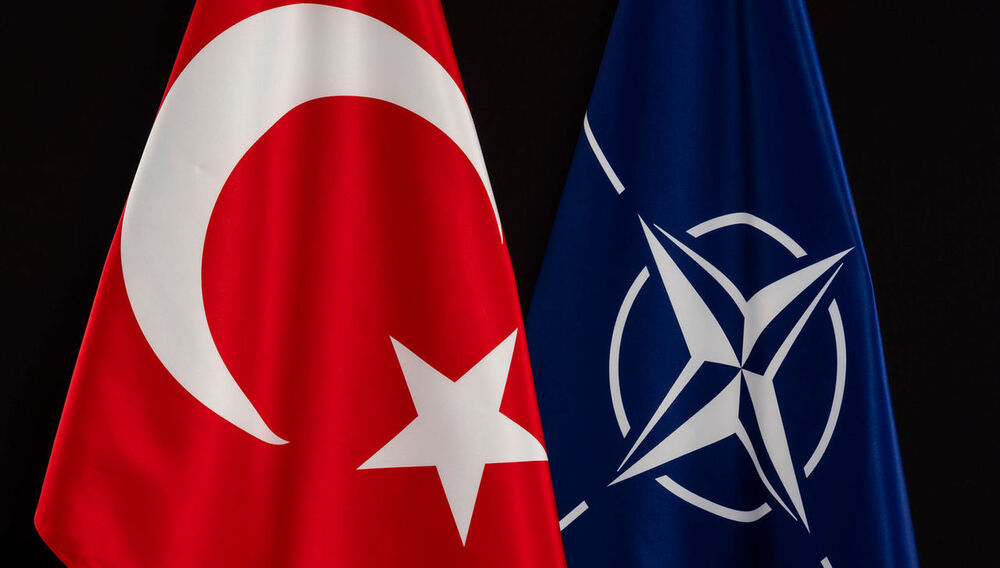
For Ankara, hosting the summit carried symbolic and practical significance. Turkey has long argued that it occupies a unique strategic position linking Europe, the Middle East, the Black Sea, and the Eastern Mediterranean. Turkish officials increasingly describe this approach as a doctrine of regional responsibility, arguing that countries directly affected by regional crises should play leading roles in resolving them.
The summit allowed Ankara to present itself not merely as a frontline NATO member but also as a regional security provider capable of contributing diplomatic initiatives, military capabilities, and industrial production.
One of the most visible elements of this effort was the Defense Industry Forum organized alongside the summit. Turkey showcased the rapid expansion of its domestic defense sector, particularly its internationally recognized drone industry led by Baykar. Parliamentary delegates visiting Ankara were taken to the company’s National Technology Center, where Turkish officials emphasized the country’s growing technological independence.
The forum also produced tangible results. More than $50 billion in new defense contracts were announced, focusing on joint production projects, industrial standardization, and expanded manufacturing capacity across NATO members.
The alliance additionally pledged approximately $40 billion over the next five years to accelerate development of unmanned systems, counter-drone technologies, and specialized operator training. These priorities closely align with Turkey’s strongest defense-industrial capabilities. Despite significant progress, Turkey’s defense industry still faces important limitations. Several flagship programs remain dependent on foreign technology.
The indigenous Kaan fifth-generation fighter has successfully completed flight testing, yet its domestically developed TF35000 engine is still under development. Similarly, Turkey continues seeking access to American military technology following sanctions imposed under the Countering America’s Adversaries Through Sanctions Act (CAATSA).
One of Ankara’s principal objectives at the summit was improving prospects for lifting these restrictions. According to Turkish officials, President Donald Trump reiterated his intention to remove CAATSA-related sanctions and reopen discussions regarding Turkey’s participation in advanced defense programs, including access to F-35 aircraft and General Electric F110 engines.
Although no final agreements were announced, the summit suggested that military-technical cooperation between Ankara and Washington may gradually improve. Turkey also used the summit to reinforce its diplomatic ambitions.
Foreign Minister Hakan Fidan argued that NATO effectively consists of three distinct political groups: the United States, European Union members, and all remaining allies. This reflects Ankara’s increasingly independent foreign policy, which seeks to balance cooperation with Western partners while simultaneously maintaining dialogue with regional actors. President Recep Tayyip Erdoğan again offered Turkey as a venue for future Russia-Ukraine peace negotiations, repeating Ankara’s longstanding position that sustainable peace requires diplomacy rather than military escalation alone. At the same time, Turkey continues making substantial operational contributions to NATO.
Turkish F-16 fighters are scheduled to join the alliance’s Baltic Air Policing mission in Estonia beginning in August 2026. Ankara will also continue commanding NATO’s Kosovo Force (KFOR) until September 2026 and is expected to lead NATO’s Rapid Reaction Force during 2028–2029. These assignments enhance Turkey’s influence over alliance operations while reinforcing its importance within NATO’s command structure. Ultimately, the Ankara summit produced mixed results for Turkey.
On the positive side, Ankara successfully demonstrated the growing competitiveness of its defense industry, secured participation in major multinational industrial initiatives, advanced discussions on easing U.S. sanctions, and strengthened its profile as one of NATO’s leading military manufacturers. Politically, however, the summit exposed the limits of Turkey’s ambitions.
Distrust between Turkey and several European allies remains substantial. While NATO values Ankara’s military capabilities and strategic geography, many European governments remain cautious about granting Turkey greater political influence within the alliance. At the same time, relations with Washington continue to fluctuate between cooperation and disagreement, particularly regarding regional conflicts and defense procurement. The Ankara summit therefore illustrated both Turkey’s growing strategic importance and the persistent challenges facing its broader geopolitical aspirations.
As NATO enters its “3.0” era – characterized by higher military spending, expanded global commitments, and greater European responsibility – Turkey appears determined to position itself not simply as another member of the alliance but as one of its indispensable regional powers. Whether that ambition can be fully realized will depend less on Ankara’s military capabilities than on its ability to reconcile its increasingly independent foreign policy with the evolving priorities of both Washington and Europe.

























Comments