


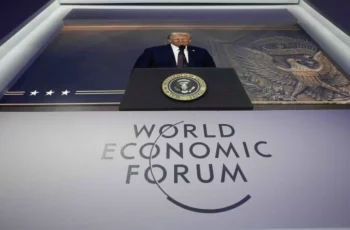
At a campaign rally in Lubbock, Texas, President Donald Trump announced that his administration is “terminating” Biden-era regulations that held oil and gas companies accountable for large leaks of methane, a potent greenhouse gas. “Tonight, I’m officially terminating Biden’s expensive and unnecessary methane regulations to save consumers and energy producers,” he said, describing the rules as “crippling regulations on methane that caused prices to skyrocket” for small operators. The announcement was made at a campaign event a week before the midterm elections, at a time when fuel prices are high because of the war with Iran. It is a policy decision, a political message and a test of how much weight the federal government gives to emissions from the oil and gas sector.
The president said the change would save consumers and energy producers $45bn and unlock 210 million barrels of oil, roughly ten days of US petroleum consumption. The Environmental Protection Agency echoed the numbers in a press release. According to the agency, the proposal is expected to save $45bn in costs to consumers and businesses, including small businesses operating marginal wells, and to produce an estimated 210 million additional barrels of oil and 1.41 trillion cubic feet of natural gas. EPA Administrator Lee Zeldin praised the move “to end the war on oil and natural gas” by revising oil and gas regulations under the Clean Air Act.
These figures come from the administration and should be read as its estimates. The logic is that compliance costs, such as monitoring, repairing leaks and limiting flaring, make some wells uneconomic, and that removing those costs would allow more production. The government also frames the measure as a response to high fuel prices: it is intended to encourage domestic drilling at a moment when Trump faces criticism over the cost of fuel stemming from the Iran war.
The 2024 methane rule required oil and gas operators to eliminate and minimise leaking, flaring and venting of methane and of volatile organic compounds, which are harmful to human health. It was the first time that the federal government set nationwide requirements to limit methane emissions from existing oil and gas facilities. A 2016 rule under the Obama administration applied only to new and modified sources. A feature of the 2024 rule was the “super emitter” programme, under which companies had to investigate major leaks near their facilities that were detected by third parties using EPA-approved remote sensing technology.
The significance of the existing-facilities requirement is that most of the industry’s methane comes from older infrastructure. A rule that covers only new equipment leaves the bulk of emissions untouched. This is why the 2024 rule was described as landmark, and why its removal is a substantial rollback.
The scale of the problem explains the reaction of critics. Last year, the United States emitted more methane from its oil and gas sector than any other country in the world, and methane is responsible for at least a quarter of today’s warming. It is much more potent than carbon dioxide over short periods, so reducing it is considered one of the fastest ways to slow warming. The volatile organic compounds covered by the rule are also harmful to human health, which gives the issue a local dimension for communities near oil and gas operations.
The Environmental Defense Fund (EDF) puts a monetary figure on the loss. Since the EPA announced in March 2025 that it would stop enforcing oil and gas regulations, operators have leaked, vented or flared $7bn worth of natural gas, according to EDF’s calculations. This is a claim from an advocacy group, but it highlights a point that is not purely environmental: methane that escapes is a product that could have been sold. The EDF’s counsel, Rosalie Winn, argued that the administration is “enabling the worst polluters in the industry to continue to make ever more money off the back of American consumers while they’re wasting energy.”
A second line of criticism concerns process. Some oil and gas executives spoke publicly in favour of the methane rule, but according to materials and Freedom of Information Act records obtained by Fieldnotes, an oil and gas watchdog, trade groups and corporations worked behind the scenes to weaken it. The records, including calendar events, presentation slides and meeting request forms, show that industry groups and companies met with the EPA about methane regulations at least 38 times in the administration’s first year.
to be continued
























Comments