


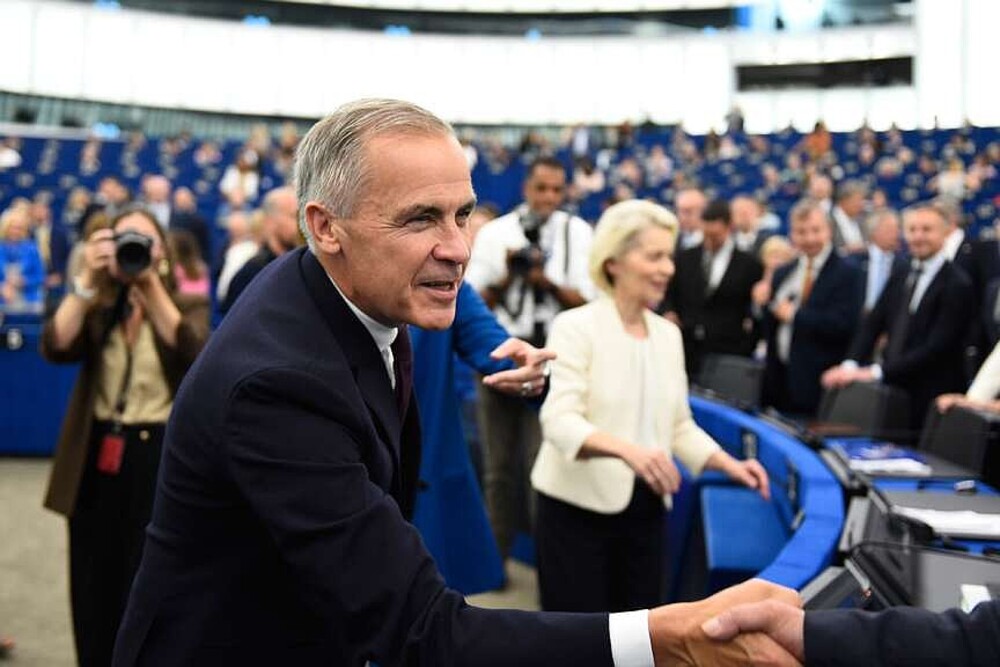
Ursula von der Leyen’s proposal to make Canada the European Union’s first-ever “associate member” produced one of the more theatrical moments of this week’s State of the European Union address: lawmakers rising to their feet, the Commission president crossing the chamber to embrace Canadian Prime Minister Mark Carney in person. The symbolism was unmistakable. What’s considerably less clear is what associate membership would actually mean in practice – a gap between the emotional resonance of the gesture and its concrete substance that several EU officials themselves have already flagged as a real problem.
Von der Leyen framed the overture explicitly around convergence of worldview rather than narrow economic interest. She told the European Parliament that the EU and Canada see the world through the same lens – on artificial intelligence, climate change, the Arctic, and broader geopolitics – and pointed to concrete instances of alignment on Ukraine, defense cooperation, raw materials, and supply chains. Her framing repeatedly returned to a single organizing principle: that the two are bound above all by a shared commitment to democracy, positioned as an anchor value at a moment she described as one of “cold fragility” in international affairs.
That language wasn’t accidental. The EU currently faces growing friction with the Trump administration over trade, and an increasingly assertive China – a convergence of pressures that has clearly pushed Brussels toward seeking new, more flexible alliances rather than relying solely on its traditional transatlantic relationship with Washington. Von der Leyen was explicit that partnerships like this represent a deliberate strategic choice for Europe, framed as a response to what she called a fracture in the broader international rules-based system, while taking care to add that the arrangement wasn’t intended as a partnership directed against any other country.
The enthusiasm in the parliamentary chamber contrasted sharply with the reaction from at least one EU diplomat, who told Reuters the proposal came as a genuine surprise and that essentially nobody understood what associate membership would actually entail in legal or practical terms. That diplomat also raised a more pointed concern: that von der Leyen risks overpromising on a concept without a clear mechanism for delivering on it. This isn’t a hypothetical worry rooted in nothing – the EU has a documented history of resisting exactly this kind of flexible, legally undefined alliance structure. When Germany proposed associate membership for Ukraine back in May, explicitly framed as a stepping stone toward full accession, the reception among EU member states was notably lukewarm, suggesting institutional resistance to this category of arrangement predates the Canada proposal by several months.
That history matters because any version of associate membership for Canada would ultimately require buy-in from EU member states themselves — von der Leyen’s proposal, however warmly received in Strasbourg, doesn’t have the authority to become policy on the Commission president’s word alone. Whether the same skepticism that greeted the Ukraine proposal resurfaces here, or whether Canada’s different strategic profile – a G7 economy with no active territorial conflict complicating the politics – earns a warmer reception from
Canada’s own positioning has been notably more restrained than the EU’s enthusiastic rollout. Carney said earlier in the week that Canada was pursuing what he called a “unique alliance” with the EU, explicitly distinguishing that goal from full membership – a clarification that suggests Ottawa may be approaching the relationship with a narrower and more concrete set of objectives than the sweeping, values-based framing von der Leyen has offered. Carney is set to deliver his own address to the European Parliament on Thursday, which should provide a clearer picture of how closely Canada’s ambitions for the relationship actually align with the EU’s.
The timing of Carney’s European outreach is not incidental. It follows a serious breakdown in Canada-US relations after trade talks collapsed last month, triggering a series of retaliatory tariff measures between the two countries. Carney has responded to that rupture with an explicit strategic pivot, pledging to double Canada’s non-US trade over the next decade as the country works to reduce its economic dependence on its southern neighbor amid an increasingly hostile trade relationship. Seen in that light, Canada’s interest in a closer EU relationship looks less like an abstract embrace of shared democratic values and more like a concrete diversification strategy forced by deteriorating relations with Washington – even if the public framing on both sides has emphasized the values dimension more heavily.
Despite the warm public rhetoric, real economic obstacles stand between the current moment and any substantially deeper EU-Canada trade relationship. Mark Manger, a professor of political economy and global affairs at the University of Toronto, noted that EU officials have grown frustrated with Canada’s continued protection of two specific industries – telecommunications and dairy – sectors Canada has historically shielded from foreign competition at considerable economic cost. Those protections aren’t a minor technical sticking point; they represent exactly the kind of entrenched domestic political interests that have derailed ambitious trade liberalization efforts between other country pairs in the past, and there’s no indication in the current announcement that Canada is prepared to reconsider its position on either sector as part of this new push for closer ties.
Von der Leyen’s speech did lay out specific areas where cooperation is meant to deepen regardless of how the associate membership question ultimately resolves: intelligent manufacturing, a joint technology alliance, integration of defense industrial bases, and a flagship joint Arctic project. Canadian Foreign Minister Anita Anand described the relationship as having grown increasingly close over roughly the past year and a half, and more detailed discussions are expected to begin at a Canada-EU summit scheduled for Montreal in late October – a meeting that should offer the first real test of whether Wednesday’s ovation translates into a concrete framework, or whether the EU diplomat’s skepticism about an undefined, unfulfillable proposal proves closer to the mark.


























Comments