


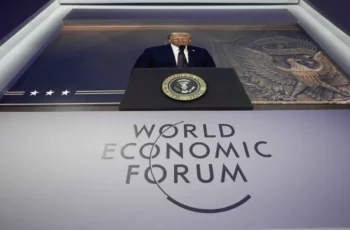
When Donald Trump threatened to “cut off all trade” with Spain following Madrid’s refusal to support military operations against Iran, the remark immediately sparked political shockwaves across Europe. The statement came shortly after Spanish Prime Minister Pedro Sánchez publicly declared that Spain would not participate in the escalating conflict in the Middle East.
At first glance, the threat appears to be another example of aggressive political rhetoric designed to pressure allies into alignment. But beyond the dramatic language lies a deeper question that touches on international law, economic integration, and the balance of power in global trade: could the United States actually suspend trade with Spain? The answer is far more complicated than the statement itself suggests. In reality, such a move would not simply target Spain – it would collide with the legal and economic architecture of the European Union and potentially trigger a major transatlantic trade conflict.
One of the key misunderstandings in the debate surrounding Trump’s threat is the nature of European trade policy. While Spain is a sovereign nation, it does not independently control its external trade relations.
Since the creation of the EU’s Single Market in 1993, authority over tariffs, trade agreements, and most commercial policy has been centralized at the European level. In other words, when the United States trades with Spain, it is legally trading with the EU as a customs union. This structure fundamentally alters the situation. Any attempt by Washington to halt trade with Spain would immediately raise a legal and political question: is the United States targeting Spain or the entire European Union?
From the EU’s perspective, the answer would likely be clear. Because trade policy is governed collectively, restrictions aimed at one member state could be interpreted as measures against the entire bloc. This would transform what appears to be a bilateral dispute into a transatlantic economic confrontation.
Beyond the legal framework, there is an economic reality that makes isolating a single EU member extraordinarily difficult. The European economy operates as a deeply interconnected production network. Manufacturing, agriculture, and industrial supply chains frequently span multiple countries. Components produced in Spain may be assembled in Germany, integrated into a final product in France, and exported worldwide. For example, a car manufactured in Germany may contain Spanish-made parts. Agricultural goods produced in Spain might be processed in another EU country before reaching international markets. These cross-border supply chains, often called global value chains, are a defining feature of modern trade. Within the EU, they are particularly dense because the Single Market allows goods to move freely between member states. This means that a hypothetical US ban on Spanish imports could inadvertently affect companies across the entire European industrial system. What appears to be a targeted sanction could therefore ripple across multiple economies.
In recent years, the international trading system has faced increasing strain. Trade wars, sanctions, and unilateral economic measures have become more common, raising doubts about the strength of global trade rules. Yet the system still rests on legal foundations – particularly those developed under the World Trade Organization. The WTO’s basic principles include non-discrimination among trading partners and the avoidance of arbitrary trade restrictions. A sweeping suspension of trade with a country such as Spain would challenge these norms directly. In legal terms, such a measure would likely provoke disputes, retaliation, and potential litigation within international trade institutions. In other words, cutting off trade would not simply be a political decision – it would ignite a legal battle that could reshape existing trade rules.
Ultimately, the viability of any American action depends less on Washington’s intentions and more on the response from Brussels. The European Commission – the EU’s executive body responsible for trade policy – has repeatedly emphasized that measures affecting one EU member state must be handled collectively. If the Commission concluded that US restrictions against Spain were harming the functioning of the EU’s internal market, it could respond with countermeasures against American goods. Such retaliation could escalate quickly.
Instead of a limited dispute between Washington and Madrid, the conflict could evolve into a broader economic confrontation between the United States and the European Union, two of the largest trading blocs in the world. This would have consequences far beyond Spain.
The political context of Trump’s threat cannot be ignored. Spain’s refusal to join the US-backed campaign against Iran reflects growing divisions among Western allies regarding military intervention in the Middle East.
For Sánchez’s government, staying out of the conflict aligns with both domestic public opinion and a broader European preference for diplomatic solutions over military escalation. For Trump, however, such dissent from an ally may be seen as undermining US leadership. The threat to cut off trade therefore functions as a form of economic pressure – a signal that political disagreements could carry financial consequences. But using trade as a geopolitical weapon carries risks. Economic coercion against allies can weaken diplomatic relationships and encourage other countries to seek alternative partnerships.
The real significance of the dispute lies not in the threat itself but in how Europe responds. If the EU stands firmly behind Spain and treats any US measures as an attack on the entire bloc, it would reinforce the principle that the union acts collectively in trade matters. However, if individual member states were left to handle such disputes on their own, it could undermine the cohesion of the Single Market. This makes the situation a crucial test of European unity. The EU was designed to give its members greater economic and political leverage on the global stage. A failure to defend one member’s position in a trade dispute could weaken that collective power.
In the end, Trump’s threat to cut off trade with Spain reveals something much larger than a diplomatic disagreement. It highlights the fragile balance between politics and economics in today’s interconnected world. Trade networks that span continents cannot easily be reshaped by unilateral decisions, even by the world’s largest economies. What begins as a political warning can quickly evolve into a legal, economic, and institutional crisis involving entire alliances.

























Comments