



In the frozen streets of Kyiv, the war has not paused for geopolitics. Russian airstrikes continue to knock out electricity, heating, and water as temperatures plunge well below zero. Residents speak of drones by sound alone, of explosions that no longer shock but exhaust. Yet while Ukraine endures another brutal winter, the world’s political spotlight has shifted elsewhere. At the World Economic Forum and across Western capitals, the dominant conversation is no longer about Ukraine’s survival or a possible end to the war. It is about Greenland – and, more broadly, about a deepening dispute between the United States and Europe.
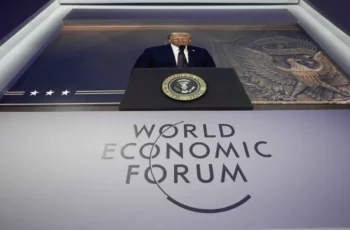
This shift matters because it reveals a hard truth: the transatlantic clash is now considered more strategically important than Ukraine. President Volodymyr Zelensky, once the central moral voice of Western politics, has faded into the background. Donald Trump’s provocative push to annex Greenland – autonomous but formally part of Denmark – has worked as a calculated distraction. By forcing Europe to respond, Trump has successfully pulled the attention of EU leaders, particularly European Commission President Ursula von der Leyen, away from Kyiv.
On paper, Ukraine should still command urgency. In recent nights, Russian attacks have again left large parts of Kyiv without power and heating. Military experts warn that Ukraine’s air defenses are increasingly overstretched. Zelensky has renewed calls for stronger economic pressure on Moscow and for additional military support. Yet even he has publicly acknowledged that his words are not resonating as they once did, even among Ukraine’s closest partners. The reason is not compassion fatigue alone – it is competition for political bandwidth.
Greenland has become the new fault line. Trump’s annexation plans, shocking in tone but deliberate in timing, have forced Europe and the United States into a confrontation over sovereignty, security, and leadership. For Washington, Greenland is about Arctic dominance, resources, and strategic positioning against Russia and China. For Europe, it is about defending territorial integrity, international law, and the credibility of the EU as a geopolitical actor. These are existential questions for both sides – and they now outrank Ukraine on the Western agenda.
The consequences are visible. Negotiations between Kyiv and Washington over a possible end to the war, recently described as “advanced,” have slipped into the background. There has been contact: a Ukrainian delegation met Trump ally Steve Witkoff in the United States, and a potential Zelensky–Trump meeting has been floated. There were even rumors of an $800 billion bilateral agreement covering Ukraine’s reconstruction and long-term security guarantees. Zelensky himself hinted that the documents were nearly ready. But momentum has stalled. In geopolitics, silence often speaks louder than promises.
Zelensky’s possible absence from Davos underscores the dilemma. Officially, he cites Ukraine’s energy crisis as a priority. Unofficially, many observers believe he is trying to avoid being caught in a public showdown between Europe and the United States. A meeting with Trump, staged against the backdrop of a transatlantic dispute, would place Ukraine in an impossible position. Neutrality would look like weakness; taking sides would be dangerous.
Ukrainian commentators have been blunt about the risk. A visible split between Washington and Brussels could force Kyiv to choose loyalties in a conflict that has nothing to do with Ukraine’s war – but everything to do with its future support. Zelensky’s cautious comments on Greenland reflect this fear. He has reaffirmed the principle of territorial integrity and expressed hope that the United States will listen to Europe. The subtext is clear: Ukraine cannot afford a rupture between its two main backers.
This is where Trump’s maneuver looks particularly shrewd. By elevating Greenland into a geopolitical flashpoint, he has re-centered global debate on American–European relations. Ursula von der Leyen and other EU leaders now spend political capital managing Trump, defending Europe’s stance, and preventing escalation. Ukraine, by contrast, has become background noise – tragic, persistent, but no longer agenda-setting.
The irony is stark. For years, Ukraine symbolized the unity of the West, the shared commitment to sovereignty and democratic values. Today, those same principles are being tested not in Kyiv, but in the Arctic. And in that test, Ukraine is no longer the main stage.
This does not mean Ukraine has lost its importance entirely. But it does mean it has lost its primacy. In the hierarchy of Western concerns, a transatlantic power struggle now outranks a war of survival on Europe’s eastern edge. Zelensky, once omnipresent in Western media and diplomacy, risks becoming an afterthought.
Trump’s gamble appears to have paid off. By shifting the spotlight to Greenland, he has forced Europe to look inward and across the Atlantic, rather than eastward to Kyiv. For Ukraine, the danger is not only bombs and blackouts, but invisibility. In global politics, being forgotten can be almost as costly as being defeated.

























Comments