



In a dramatic escalation of Middle East tensions, the United States and Israel launched a joint military campaign against Iran on February 28, 2026, resulting in the death of Iran’s Supreme Leader Ayatollah Ali Khamenei and triggering widespread retaliation across the region.
The crisis – the most serious confrontation between Tehran and Washington in decades – shifted swiftly from diplomacy to open warfare and has reverberated across global politics. This article synthesizes verified developments, confirmed strikes, official statements, and the immediate military and diplomatic fallout.
On February 28, the United States and Israel commenced a coordinated military operation against Iran, known in U.S. sources as “Operation Epic Fury” and in Israeli sources as “Operation Roaring Lion.” The campaign involved: U.S. air and missile strikes (Tomahawk cruise missiles, F-35 support), Israeli Air Force strikes across multiple Iranian cities, Targeted attacks on nuclear facilities, missile infrastructure, and leadership compounds.
Most consequentially, Iran’s Supreme Leader, Ayatollah Ali Khamenei, was killed in a targeted strike on his Tehran compound. Iranian state media confirmed his death and announced a national mourning period.
U.S. President Donald Trump publicly confirmed the assassination, describing Khamenei as a threat to regional and global security. Israeli Prime Minister Benjamin Netanyahu endorsed the strikes as necessary to neutralize Tehran’s capacity for harm.
“Khamenei, one of the most evil people in history, is dead,” Trump wrote. “He was unable to avoid our intelligence and highly sophisticated tracking systems and, working closely with Israel, there was not a thing he, or the other leaders that have been killed along with him, could do.”
The strikes also killed senior Iranian defense officials, including commanders of the Revolutionary Guards and top political advisers.
Within hours of the strikes Iran launched multiple waves of missile and drone attacks against U.S. military bases and Israeli positions across the Middle East. Targets included U.S. bases in Qatar, Kuwait, United Arab Emirates, Bahrain, and Saudi Arabia, as well as Israeli facilities. Iran’s Islamic Revolutionary Guard Corps (IRGC) declared it would conduct the “most ferocious offensive operation in history” against U.S. and Israeli forces.
Iranian state agencies reported significant casualties among U.S. and allied personnel, though Western officials have offered no independent confirmation of casualties.
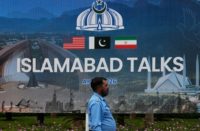
Though this confrontation did not emerge out of nowhere. In February 2026, the U.S. and Iran had resumed diplomatic talks after years of frozen engagement, focusing on Iran’s nuclear program with Oman acting as intermediary.
However, negotiations faltered as both sides clashed over core issues: Tehran insisted on lifting sanctions and limiting external interference and Washington demanded strict limits on nuclear enrichment and broader constraints on Iran’s missile program and regional proxies. In the face of stalled talks, Washington decided that military pressure was necessary to prevent Tehran from acquiring an operational nuclear weapon and long-range missile capability, according to official U.S. statements.
U.S. justifications for military action included halting Iran’s advancing nuclear program and stopping enrichment at weapon-relevant levels; Neutralizing ballistic missile threats in the region capable of hitting U.S. allies; Reducing Tehran’s influence through proxy groups across the Middle East; Pressuring regime change to avert future threats. Israeli leadership stressed that a nuclear-armed Iran posed an existential threat to the state of Israel, motivating Tel Aviv to coordinate strikes closely with Washington.
The conflict has also impacted neighboring countries: missile fragments from Iranian retaliation have struck parts of Abu Dhabi and Bahrain, with at least one fatality reported, airspaces across the Gulf region have been restricted due to security threats, global oil and energy markets are experiencing volatility in anticipation of disruptions in the Strait of Hormuz — a key shipping lane.
The crisis has drawn global attention as the United Nations Security Council held emergency sessions over the spiraling conflict. Secretary-General António Guterres told the council that everything must be done to prevent an escalation. “The alternative,” he warned, “is a potential wider conflict with grave consequences for civilians and regional stability.”
Russia and China criticized the attacks and called for a halt to military operations. “We demand that the United States and Israel immediately cease their aggressive actions,” Russian U.N. Ambassador Vassily Nebenzia said. “We insist on the immediate resumption of political and diplomatic settlement efforts … based on international law, mutual respect and a balance of interests.”
But as of today, Iran’s military has vowed sustained operations, while U.S. officials affirm readiness to continue strikes until the Iranian regime’s strategic capacities are sufficiently degraded. The death of Ayatollah Khamenei — a rare and historic event — has removed a central figure in Tehran’s governance. Iran’s Supreme National Security Council has declared a period of mourning and vowed revenge.
Diplomatic avenues remain tenuous but may re-emerge if fighting stabilizes or external powers mediate. Europe and other international actors have reiterated calls for negotiation even amid violence.


























Comments