


We don’t know what was said in Washington, but we can assume that the United States took a firm stance toward Ukraine, even if it didn’t want to risk destroying Atlantic solidarity. Thierry Meyssan presents here what transpired during this tumultuous week.
To understand the week of peace negotiations in Ukraine, it is essential to first dispel the misinformation disseminated by the mainstream press: contrary to what they implied, the Europeans were never allowed to join the Geneva talks.
It is also worth recalling what I explained last week [1]: European governments have no interest in peace; they even fear it: it would undoubtedly bring about their own downfall.
It is therefore no coincidence that the German, British, and French press claimed that the Geneva peace plan was a European document. They asserted this so strongly that we ourselves repeated this falsehood before correcting it.
With that established, let us review the sequence of events:
When the peace plan, drafted by the United States and Russia in Florida, became public [2], the subservient commentators presented it as “outrageously pro-Russian.”
The Geneva Negotiations
The Ukrainians requested to draft a counter-proposal with the United States. Talks were held in Geneva on November 23 and 24.
However, on November 22, EU leaders, along with the British, Norwegians, and Japanese, all attending the G20 summit of heads of state and government in Johannesburg, issued a joint statement. It reads:
“We are ready to commit to ensuring that future peace is lasting. We are clear on the principle that borders must not be changed by force. We are also concerned about the proposed restrictions on the Ukrainian armed forces, which would leave Ukraine vulnerable to future attack.
We reiterate that the implementation of elements relating to the European Union and those relating to NATO would require the consent of the respective EU and NATO members.”
Germany, France, and the United Kingdom therefore sent diplomats—uninvited—to the Intercontinental Hotel where the US and Ukrainian delegations were staying. They were able to speak with both sides but were not admitted to the negotiations.
The document, released after the talks, reiterates only the Ukrainian arguments [3].
It no longer mentions the denazification of Ukraine, the country’s neutrality, or EU participation in its reconstruction. It is therefore unacceptable from a Russian perspective.
Presenting his work to the press, State Secretary Marco Rubio simply stated that things were progressing very well. This is probably because Ukraine had renounced the reconquest of territories occupied/liberated by Russia and accepted their international recognition as Russian.
The “Coalition of the Willing”
On November 25, the Coalition of the Willing, established on March 1, 2025, by General Petr Pavel, Czech President and former Chairman of NATO’s Military Committee, and by Keir Starmer, British Prime Minister, met via videoconference.
The term “Coalition of the Willing” refers to President George Bush and his 2002 National Security Strategy. At the time, the aim was to bring together the allies (excluding Jacques Chirac’s France and Gerhard Schröder’s Germany) to invade Iraq. This coalition claimed to represent international law. To this end, the United Kingdom officially disseminated numerous pieces of fake news, which were later investigated by the Commission of Sir John Chilcot.
The United Kingdom had similarly disseminated a large amount of fake news, secretly conducting drone flights over Belgian, Danish, Estonian, Norwegian, Polish, and Romanian airports. It had offered its own experts to the bewildered smaller nations and provided them with its own answers [4]. It had thus persuaded them that Russia was preparing to attack the European Union.
It is worth recalling that at the NATO summit in Wales (2014), the United Kingdom created a mini-NATO within NATO—the Joint Expeditionary Force (JEF). It comprised Denmark, Estonia, Finland, Iceland, Latvia, Lithuania, Norway, the Netherlands, and Sweden, under British command.
This mini-NATO deployed Operation Nordic Warden when damage was reported to the Estlink2 undersea cable in the Baltic Sea.
Not only did member states forget that it was the Ukrainians and/or the Americans who sabotaged the Nord Stream gas pipelines, but they also believed that the damage to these cables might have been caused by the Russians.
On November 5, 2025, the United Kingdom included Ukraine, a non-NATO member, in this Joint Expeditionary Force (JEF).
The meeting of the “Coalition of the Willing” on November 25 was co-chaired by Emmanuel Macron (President of France), Keir Starmer (Prime Minister of the United Kingdom), and Friedrich Merz (Federal Chancellor of Germany). It is worth noting that while 38 states, NATO, and the EU participated, George Soros was represented by Radmila Šekerinska, the Macedonian Deputy Secretary General of NATO.
President Macron outlined the approach, stating that all participants should remain “united to support a just, dignified, and lasting peace for Ukraine that would preserve its sovereignty and ensure its long-term security.” Prime Minister Starmer emphasized the importance of reliable security guarantees and strengthening Ukraine’s air defenses. London, which does not wish to engage in a confrontation with Russia, hopes to isolate it behind an “iron curtain,” as Winston Churchill did in his Fulton speech.
Finally, Chancellor Merz welcomed the common position of the United States, Ukraine, and the European Union and stressed the need to negotiate with Russia.
The volunteers listened to a report on the Geneva negotiations, in which only the United States participated.
Wiretaps
On November 25, the business news agency Bloomberg published a transcript of a phone conversation, recorded without their knowledge on October 14, between Steve Witkoff, Donald Trump’s special envoy, and Yuri Ushakov, the former Russian ambassador to Washington who had become Vladimir Putin’s diplomatic advisor. The Democratic-leaning news agency also published a transcript of another conversation, this time from October 29, between Ushakov and Kirill Dmitriev, Putin’s special envoy who represented him during the negotiations in Florida [«Putin advisers discuss plans for dealing with Trump:Transcript», Bloomberg, November 25, 2025. Version française de la première écoute : «L’intégralité de la conversation entre Steve Witkoff, envoyé spécial de Donald Trump, et Iouri Ouchakov, conseiller diplomatique de Vladimir Poutine, révélée par Bloomberg», Le Monde, 26 novembre 2025.]]. Kirill Dmitriev immediately called this second wiretap “fake.”
The first call was a suggestion from Witkoff that President Putin should propose a 20-point plan modeled on President Trump’s plan for Gaza. The second implied that Russia had played a major role in the Florida peace plan.
These two conversations, which had been intercepted by an intelligence service, were used to create the impression that the Florida plan had been drafted solely by Russia. However, anyone familiar with how such negotiations are conducted would be astonished by this. They in no way suggest that Witkoff was a Russian spy, but simply that he was doing his job.
A simple reading of the plan reveals that it stipulates Russia will spend $100 billion to rebuild Ukraine and that it does not recognize the Odessa Oblast as Russian—even though this recognition would have allowed Transnistria’s request to leave Moldova and join the Russian Federation to be accepted.
According to the Wall Street Journal, these wiretaps not only provide a distorted view of the negotiations, but they also miss the essential point. On August 7, Steve Witkoff reportedly informed the “Coalition of the Willing” that President Putin was prepared to relinquish Kherson and Zaporizhzhia if Ukraine recognized the annexation of all of Donbas (including the tiny portion still under Ukrainian control). Skeptical, the Europeans reportedly rejected these overtures, convinced that Russia intended to conquer all of Ukraine and then attack the European Union. [5]
No one knows which intelligence agency carried out these wiretaps, more than a month before their publication, but our eyes naturally turn to the banks of the Thames. During a visit to Kyrgyzstan, President Vladimir Putin reiterated that, in his country, eavesdropping on telephone conversations is a criminal offense. [6]
Belgium’s Refusal to Seize Frozen Russian Money
On November 27, Belgian Prime Minister Bart De Wever and the clearing house Clearstream sent two letters to the European Commission. They firmly opposed the confiscation of $215 billion in frozen Russian deposits [7].
Almost all experts believe that converting these frozen assets into “repair loans” would amount to seizure. Only British experts claim that equating this with theft is “nonsense.”
It is true that, according to a study by the Norwegian Institute of International Affairs (NUPI), a defeat of Ukraine, with the resulting refugee migration, would be twice as costly for the European Union as maintaining the current situation [8].
If nothing changes, Ukraine will default by the end of June at the latest.
The Fall of the Ukrainian Presidential Administration
On November 28, while the White House was inviting unelected President Volodymyr Zelensky to meet with President-elect Donald Trump in Washington, the National Anti-Corruption Bureau of Ukraine (NABU)—assisted by 80 U.S. inspectors seconded by the State Department—searched the home of Andriy Yermak, the all-powerful head of the presidential administration. Although the press had reported a search of Yermak’s offices, it was his home that investigators ransacked from 6:00 a.m. to 1:00 p.m. They seized numerous cell phones.
The defendant immediately resigned, thus avoiding censure by the Verkhovna Rada. He announced his decision in a letter to the New York Post [9]. In it, he wrote:
“I have been defiled, and my dignity has not been protected, even though I have been in Kyiv since February 24, 2022. Therefore, I do not want to create problems for Zelensky; I am going to the front lines… I am disgusted by the filth directed at me, and even more disgusted by the lack of support from those who know the truth.”
Thus, on the one hand, Marco Rubio was meeting with Andriy Yermak in Geneva four days earlier, and on the other, investigators from his State Secretariat were removing Andriy Yermak from political life.
Taking advantage of the war and Volodymyr Zelensky’s bipolar policies, Andriy Yermak, who was only the second-highest-ranking civilian official, had become the most powerful man in the country. According to investigators from the National Anti-Corruption Bureau (NABU), he was the one the corrupt officials called “Ali Baba,” the man who coordinated all the bribes and embezzlement. While he is implicated in the theft of around one hundred million euros from energy contracts, he is believed to have actually stolen billions of euros from arms deals.
Following many others, Yuriy Kamelchuk, a member of parliament from Zelensky’s party, is also reportedly on the run.
Simultaneously, on November 28, Viktor Orbán, the Hungarian Prime Minister and a personal friend of both Vladimir Putin and Donald Trump, visited the Kremlin, officially to discuss supplying his country with Russian hydrocarbons, but unofficially to continue contacts between Washington and Moscow. He was accompanied by Marcel Biro, his national security advisor, while President Putin was accompanied by Yury Ushakov, his diplomatic advisor whose conversation with Steve Witkoff had been monitored [10].
Prime Minister Orbán’s trip to Moscow violated “European Union solidarity” but was in line with the special privilege granted to him by President Donald Trump to negotiate his country’s hydrocarbon supplies.
Back to Florida
According to a decree issued by the unelected president, the Ukrainian delegation to participate in peace talks in Florida comprises nine people, including the Secretary of the National Security and Defense Council, Rustem Umerov (who is currently a fugitive), the head of Military Intelligence, General Kirill Budanov, the Deputy Chief of the SBU, General Oleksandr Poklad, and the Chief of the General Staff of the Armed Forces of Ukraine, the staunch nationalist General Andriy Hnatov. It is not impossible, however, that Andriy Yermak will be part of the delegation, despite having resigned.
Rustem Umarov, former head of Ukraine’s sovereign wealth fund, came to the United States just before the Florida negotiations. He met with FBI Director Kash Patel. Umarov is likely a CIA agent who served under MP Mustafa Abdülcemil Cemiloğlu (alias Mustafa Dzhemilev) [11]. He probably made a deal with the US justice system. He was the one who assured Steve Witkoff that Zelensky would accept the Florida plan. The fact that he is leading the Ukrainian delegation this weekend, even though he has already fled, seems to indicate that Washington holds all the cards.
Final warm-up
At the time of writing, nothing has leaked from the Washington meeting. However, on November 30, Ursula von der Leyen, President of the European Commission, called Volodymyr Zelensky. She assured him that Ukraine must stand firm, despite the Russian army’s bombing of its energy facilities.
Then Mark Rutte, NATO Secretary General, also called him. He seems to have been less enthusiastic and cautious about US support.
Finally, French President Emmanuel Macron invited his unelected counterpart to visit him in Paris the following day, December 1st. He could only maintain the illusion. On November 17th, he had indeed pompously signed documents for the sale of 100 Rafale fighter jets, SAMP/T air defense systems, modern air defense radars, air-to-air missiles, and guided bombs to Ukraine. In reality, these were not contracts, but “declarations of intent.” The financing for these extravagant sales was not guaranteed, and their manufacture by Dassault Aviation could not begin for five to ten years.
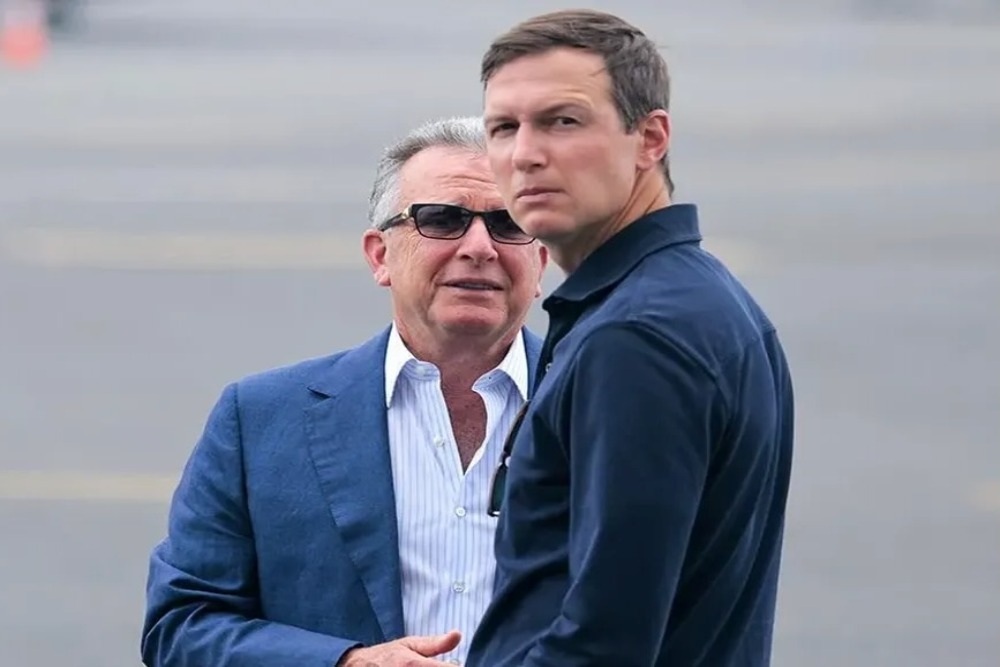
Meanwhile, Steve Witkoff and Jared Kushner will be at the Kremlin.
[1] “The Fall of Zelensky’s Regime and Those of His Allies”, by Thierry Meyssan, Translation Roger Lagassé, Voltaire Network, 28 November 2025.
[2] “Trump’s peace plan for Ukraine”, Voltaire Network, 20 November 2025.
[3] “Ukrainian peace plan”, Voltaire Network, 24 November 2025.
[4] «“Het is gissen waarom we niet werden opgeroepen”: gespecialiseerd counter-droneteam werd niet ingezet bij drones boven Zaventem vorige week», Dirk Coosemans, Newsblad, 10 november 2025.
[5] «Make Money Not War: Trump’s Real Plan for Peace in Ukraine», Drew Hinshaw, Benoit Faucon, Rebecca Ballhaus, Thomas Grove and Joe Parkinson, The Wall Street Journal, December 1, 2025.
[6] «US peace plan, special military operation, contacts in UAE: what Putin said», Tass, November 27, 2025.
[7] «Belgian PM raises stakes on Kyiv lifeline, renewing opposition to Russian frozen-assets reparations loan», Luca Léry Moffat, Kiyv Independent, November 28, 2025.
[8] To scenarier for krigen i Ukraina: Hva betyr de for Europa – og hva vil det koste? ou version anglaise : Europe’s choice: Military and economic scenarios for the War in Ukraine, Erlend Bjørtvedt, Karsten Friis, Trygve Johannes Smidt, John Karlsrud, Olav Slettebø, Ole Martin Stormoen and Casper Waagbø, Corisk & Norwegian Institute of International Affairs, November 28, 2025.
[9] «Former top Zelensky aide sends The Post ominous message hours after resignation: ‘I’m going to the front’», Caitlin Doornbos, New York Post, November 28, 2025.
[10] «Встреча с Премьер-министром Венгрии Виктором Орбаном», Кремль, 28 ноября 2025 года.
[11] « L’Ukraine et la Turquie créent une Brigade internationale islamique contre la Russie », par Thierry Meyssan, Télévision nationale syrienne, Réseau Voltaire, 12 août 2015.
Source: Voltaire Network



















Comments