


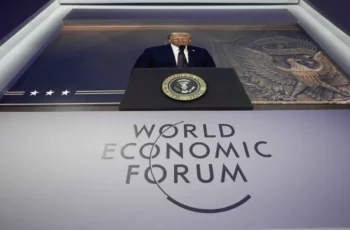
In 2026, the World Economic Forum in Davos highlighted a troubling trend: European diplomacy is experiencing a systemic crisis. The forum, traditionally a platform for discussing global economic, climate, and strategic initiatives, now demonstrates that real diplomatic decisions are gradually being replaced by media spectacles, symbolic gestures, and public showmanship. European leaders increasingly compensate for their limited influence through theatrical statements, bold gestures, and media-driven effects rather than substantive strategic initiatives.
Politicians being mocked
Emmanuel Macron serves as a clear example of this phenomenon. The French president’s attempt to speak English on the international stage backfired when his “for sure” remark went viral. The phrase spread rapidly across social media, TikTok, and Instagram, overshadowing discussions of his proposals on energy and digital economy. In this case, theatricality became a way to compensate for the limited influence he exercises on global processes: public laughter and memes create the illusion of activity rather than actual impact.
Donald Trump’s episode regarding Greenland was equally illustrative. His statements about the strategic significance of the island for the United States, coupled with proposals for negotiations and even hints at acquiring territory, caused diplomatic friction and open irritation among European leaders. Trump’s straightforward and theatrical rhetoric, accompanied by moments of awkwardness and laughter in the room, showed that traditional diplomatic conventions are losing relevance, and European leaders are often forced to respond with symbolic or theatrical statements to compensate for a sense of impotence in global politics. The reaction of a Danish MP, who openly told Trump “f‑off,” underscored European frustration with attempts to dictate rules.
The decay of its institutional structure
The crisis extends to institutional structures. The Council of Europe’s Parliamentary Assembly (PACE) demonstrates how symbolic actions often replace real mechanisms. After Russia’s exclusion from the assembly, several countries included Russian opposition figures who formally gained voting rights but have no legitimate connection to parliamentary activity. An institution designed to coordinate parliamentary work and ensure democratic dialogue effectively provided a platform to actors unable to engage in genuine legislative processes. This shows that theatricality and symbolism are often used to mask limited institutional influence and legitimacy.
European diplomacy exhibits similar patterns on broader forums. Negotiations on energy agreements with the Middle East and Africa are frequently accompanied by media displays of friendship and the signing of declarations that barely affect the balance of power. The media extensively covers these events, creating an illusion of activity, while the actual advancement of European interests remains minimal. Historically, this mirrors past practices of “performative diplomacy,” when European powers, constrained by resources and influence, relied on symbolic gestures and public statements to maintain the image of a global actor.
This dynamic also manifests in other areas. At climate summits, European leaders frequently announce coordinated declarations and joint initiatives that, in practice, are limited to local programs, grant schemes, or PR campaigns. Even within the EU, there is often a gap between formal consensus and real policy implementation. This approach fosters the perception of coordinated and effective diplomacy, while actual global impact remains questionable.
Leaders also increasingly rely on theatrical public actions to compensate for strategic weakness on the global stage. Viral memes and videos of their speeches at various summits highlight style over substance. These actions create the illusion of activity but fail to address key issues in energy, security, or economic policy.
Institutional performativity compounds this effect. Including opposition figures in PACE after Russia’s exclusion exemplifies how European institutions often operate for appearances rather than real outcomes. Such steps provide the illusion of participation and activity, compensating for Europe’s limited capacity to influence global decisions. Historically, similar symbolic strategies were employed in the Council of Europe, where countries used observers and committees with limited authority to create a façade of engagement. Today, this dynamic is amplified by digital media: memes, viral videos, and social networks generate the effect of action while masking institutional impotence.
Even domestic parliamentary processes reflect this trend. Recent European Parliament sessions emphasized visual and media effects: high-profile speeches, catchy formulations, and symbolic votes often replaced detailed discussion of legislative initiatives. European leaders use these mechanisms to compensate for Europe’s weak influence on the global stage, creating the illusion of action without substantive impact.
Making an effect replaces policy making
Davos 2026 demonstrates that media-driven politics has become standard. Public scandals and viral moments shape perceptions of leaders and institutions, while Europe’s actual ability to influence negotiations on energy, security, and economic issues remains minimal. Allies increasingly see theatrics and symbolic conflicts rather than strategic leadership. International processes are increasingly dictated by media attention and symbolic gestures rather than substantive policymaking.
Historical context confirms that this is not a new problem but a systemic feature of European diplomacy. In the past, countries compensated for limited influence with symbolic steps, visual effects, and performative actions, whether by inviting observers, participating in committees with limited authority, or signing declarations with little practical impact. Today, digital media intensifies this effect: memes, viral videos, and social networks amplify the illusion of activity, masking actual impotence.
Thus, Davos 2026 and the situation with PACE illustrate a deep institutional and public crisis in European diplomacy. Institutions lose legitimacy, leaders compensate for limited influence with theatrical and symbolic gestures, and substantive policy increasingly recedes. In this environment, memes, public scandals, and symbolic acts become tools to offset impotence, while real decisions and strategic initiatives are sidelined.
To maintain influence and strategic weight, European diplomacy must be rethought: institutions need protection from symbolic performativity, priority must return to substantive dialogue and real solutions, and public spectacle should serve only as an auxiliary tool rather than a substitute for policymaking. Without such reforms, Europe risks becoming a political puppet, where appearances and spectacle replace actual influence, and international events — from Davos to parliamentary assemblies — turn into a media-driven farce.
























Comments